Lake Nakuru National Park is a compact, fenced Rift Valley park famous for rhino, flamingos and Rothschild’s giraffe, set around a shallow soda lake about 160 kilometres from Nairobi. African Safari Trails arranges Lake Nakuru safaris and day trips, one of Kenya’s most reliable parks for seeing rhino. Both black and white rhino live here, alongside lions and rich birdlife.
Lake Nakuru packs a great deal into a small, fenced space. Built around a shallow soda lake in the Great Rift Valley, it is one of the best places in Kenya to see rhino, with both black and white roaming the lakeshore and grasslands, plus the rare Rothschild’s giraffe, lions and, when conditions suit, the famous pink fringe of flamingos. Close to Nairobi and easy to cover in a day or two, it delivers a lot per hour. African Safari Trails builds it into a Rift Valley circuit.
Why Visit Lake Nakuru National Park
Lake Nakuru is chosen for efficiency and rhino. Compact, fenced and high in wildlife density, it offers some of the most reliable rhino viewing in Kenya, the only park where both black and white rhino are seen readily in a single visit, with far less driving than the big open reserves.
Add Rothschild’s giraffe, tree-climbing lions, dramatic Rift Valley viewpoints and the chance of flamingos, and it earns its place on most Kenya circuits. It works as a day trip or a one-to-two-night stay. The wildlife return per hour is high. African Safari Trails uses it as an efficient, rewarding leg of a longer trip.
Rhino Tracking: Black and White
Rhino tracking is the headline at Lake Nakuru, which has long been one of Kenya’s most important protected areas for the animal, fenced around its full perimeter against poaching. Both species live here, white rhino grazing the short grass by the lake and the shyer black rhino keeping to thicker bush.
The southern section holds the best chances, and the park’s population numbers around 150, making sightings reliable, though never guaranteed. Spotting both species in a single drive is rare elsewhere in Kenya. Early mornings are most productive. African Safari Trails knows the areas where rhino gather.
Most parks make you earn a rhino. Lake Nakuru hands you two kinds. A white rhino crops the short lakeshore grass like a grey boulder come to life, calm and close, while somewhere back in the acacia thicket a black rhino keeps its own counsel. Add a tree-climbing lion draped over a branch and a far shore stitched pink with flamingos, and the small fenced park starts to feel a great deal bigger than its map.
Flamingos and the Soda Lake
Lake Nakuru built its early fame on flamingos, the shallow alkaline lake once drawing well over a million lesser and greater flamingos to feed on its algae, fringing the shore in deep pink. It remains one of the images most associated with Kenya.
Numbers are far less predictable now, as rising water levels have changed the lake’s chemistry and many birds have shifted to other Rift Valley lakes like Bogoria, so the great pink carpets come and go. Treat the flamingos as a fine bonus rather than a certainty. The park rewards regardless. African Safari Trails sets honest expectations about what you will see.
Rothschild’s Giraffe and Wildlife Watching
Wildlife watching at Lake Nakuru turns up far more than rhino. The endangered Rothschild’s giraffe, brought here from western Kenya for its protection, browses the acacia woodland, recognisable by its pale colouring and the way its markings stop above the knee, as if wearing white socks.
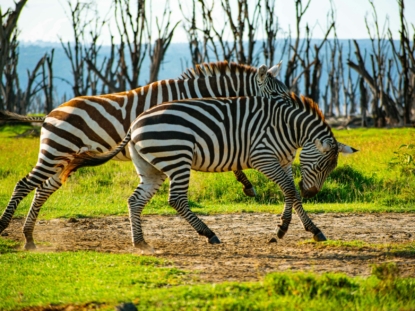
The park also holds buffalo, common waterbuck, zebra, eland, impala, hippo, olive baboon, lion, leopard and the occasional cheetah, with large pythons sometimes seen in the trees or crossing the road. The fenced, compact range keeps it all in reach. Sightings stay reliable. African Safari Trails pairs you with guides who read the woodland.
Game Drives in a Compact Park
A game drive at Lake Nakuru is efficient by nature, since the fenced, high-density park means short distances between sightings and little wasted travel. A loop takes in the lakeshore, the rhino areas in the south, the acacia woodland for giraffe and the grasslands for predators.
The compact size makes one productive day possible, though a morning and an afternoon drive over a single night give the best light and the most active wildlife. The lakeshore is the centre of the action. Less driving means more watching. African Safari Trails plans a drive route that covers the park’s variety.
Bird Watching at Lake Nakuru
Bird watching is outstanding here whatever the flamingos are doing, with over 400 species recorded and the park recognised as an Important Bird Area. The lake draws great white pelicans, cormorants, African fish eagles, Goliath herons, hamerkops and pied kingfishers, while the woodland and grassland add many more.
Marabou storks stalk the shallows and raptors work the escarpments, so a birding list builds quickly. The wetlands keep the birdlife strong all year. Birding pairs naturally with the game viewing. African Safari Trails can build a birding focus into a Nakuru visit.
Black and white rhino
One of Kenya’s best parks for rhino, with both species seen readily in the south, around 150 animals in a fenced, guarded range.
Rothschild’s giraffe
The pale, endangered subspecies with no markings below the knee, browsing the acacia woodland after being brought here for safety.
Flamingos when conditions suit
The famous pink fringe of lesser and greater flamingos, a fine bonus now that numbers vary with the lake’s rising water.
Lions, birds and viewpoints
Tree-climbing lions, leopard, buffalo, 400-plus bird species and Rift Valley lookouts at Baboon Cliff and Lion Hill.
Combining Nakuru on a Safari Circuit
Lake Nakuru fits naturally into a wider Kenya safari, helped by its closeness to Nairobi and its position on the Rift Valley route. It pairs with nearby Lake Naivasha for a boat trip and a walk among giraffe and zebra on Crescent Island, and with Hell’s Gate National Park for cycling and hiking.
It also slots in on the way to or from the Maasai Mara, making an efficient wildlife stop on a longer loop, and a short drive from the capital puts Nairobi National Park within easy reach at the start or end. As a day trip from Nairobi it is one of the most popular options going. The links are easy. African Safari Trails builds it into a Rift Valley or Mara circuit.
Best Time for a Lake Nakuru Safari
The dry season is the easiest time for a Lake Nakuru safari, when wildlife gathers at the lake and the roads are firm. Flamingo numbers follow the lake’s own rhythm rather than the calendar, so they are never guaranteed.
June to October (long dry season)
The best for game viewing, with rhino, giraffe and predators drawn to the lake and good roads through the compact park.
January to February (short dry season)
Dry, mild and quieter, with reliable wildlife around the lakeshore and pleasant conditions for the Rift Valley viewpoints.
March to May, November (rains)
Green and quiet with lower rates, often the better chance of flamingos when the lake suits them, though some tracks turn muddy.
Come for the rhino, treat flamingos as a bonus, and pack a warm layer for early drives. Lake Nakuru is at its best as a rhino park, so prioritise an early-morning drive through the southern rhino areas when the animals are most active, and bring binoculars for the shy black rhino in the bush. Do not build the whole trip around flamingos, since their numbers now rise and fall with the lake’s changing water and they may have moved to Bogoria or Natron. The park sits at altitude in the Rift Valley, so dawn drives are cold even when the days are warm. African Safari Trails sets the route and honest expectations.
Getting There and Practicalities
Lake Nakuru lies in the Great Rift Valley about 160 kilometres north-west of Nairobi, a drive of roughly two and a half to four hours on the main highway, with charter flights reaching nearby airstrips in well under an hour. The main gate sits near Nakuru town.
Entry is run by KWS on a cashless, prepaid basis through the eCitizen system, with fees set by visitor category, and the park is fully fenced with the usual plastic-free and stay-in-vehicle rules. Its closeness to Nairobi makes a day trip realistic. African Safari Trails arranges the tickets, transport and guide.
Lake Nakuru National Park FAQ
How much does Lake Nakuru National Park cost to enter?
Lake Nakuru is a KWS premium park, so non-resident adult fees are higher than the standard parks, currently in the region of 100 US dollars per day, with much lower rates for African citizens, East African citizens and Kenya residents, and reduced rates for children, charged per 24-hour stay. African Safari Trails includes the correct park fees in a clear, all-in quote.
Will I definitely see rhino at Lake Nakuru?
No wildlife is ever guaranteed, but Nakuru is one of the most reliable parks in Kenya for rhino, with both black and white present and white rhino often grazing in the open near the lake. The southern section and early mornings give the best chances. African Safari Trails knows where they tend to gather.
Are the flamingos always there?
No. The great pink flocks come and go with the lake’s water level and algae, and in high-water years many flamingos move to other Rift Valley lakes such as Bogoria. Treat them as a bonus rather than a certainty, and the park’s rhino, giraffe and birdlife reward you regardless. African Safari Trails sets honest expectations.
How many days do you need at Lake Nakuru?
One day covers the park for rhino and birds, since it is compact, while a two-day stay with a night inside or nearby adds sunrise and sunset drives and better light. A day trip from Nairobi is realistic but long. African Safari Trails sets the right length for your trip.
Can you do Lake Nakuru as a day trip from Nairobi?
Yes, and it is one of the most popular day trips in Kenya, with an early start giving a full morning and afternoon of game viewing before returning to the city. An overnight stay is better for rhino tracking at first light. African Safari Trails arranges either a day trip or an overnight visit.
When is the best time to visit Lake Nakuru?
The dry seasons from June to October and January to February are best for game viewing, with wildlife at the lake and firm roads, while the green months can bring better flamingo chances but some muddy tracks. African Safari Trails times your safari for the best conditions.
Plan Your Lake Nakuru Safari with African Safari Trails
Finding both rhino species in a morning, setting honest expectations about the flamingos, and pairing the park with Naivasha or the Mara all go more smoothly with someone who knows Lake Nakuru, so you come away with the wildlife rather than a search for birds that have moved on. African Safari Trails has spent years building Rift Valley and Mara safaris that take in Nakuru, with guides who know the rhino areas and the giraffe woodland by instinct rather than a brochure. They will tell you straight what the park reliably offers, whether a day trip or an overnight suits you better, and handle the tickets, transport and transfers quietly in the background.
Nakuru pairs beautifully with the Mara on our 4 Days Masai Mara & Lake Nakuru tour, one of many Kenya safaris that thread the park into the wider network of Kenya national parks.
Want a proper quote, or just a steer on building a Rift Valley trip? Reach out to African Safari Trails and a real person gets back to you.