Tsavo East National Park is Kenya’s largest park, a vast semi-arid wilderness of red-dust elephants, the Galana River and the Yatta Plateau, lying between Nairobi and the coast. African Safari Trails arranges Tsavo East safaris and bush-and-beach trips, often paired with the Kenyan coast. Big herds, big space and few crowds define this raw, atmospheric park.
Tsavo East is safari on a grand scale. Spread across nearly 14,000 square kilometres of dry plains and thornbush, it is Kenya’s biggest park and one of its wildest, famous for the herds of elephants stained brick-red by its iron soil. Add the Galana River, the longest lava flow on earth and the legend of the man-eating lions, and you have a park of space and atmosphere rather than crowds. African Safari Trails builds it into a wild, uncrowded safari, often with beach time to follow.
Why Visit Tsavo East National Park
Tsavo East is for travellers who want space and wilderness over a checklist of close sightings. At nearly 14,000 square kilometres it is Kenya’s largest park, and you can find a herd of red elephants at the river with not another vehicle in sight, a world away from the busy Mara.
It trades sightings-per-hour for atmosphere, room and a sense of genuine wild, with dramatic scenery and far fewer crowds. Its position between Nairobi and the coast makes it the natural bush half of a bush-and-beach trip. The scale is the appeal. African Safari Trails matches it to travellers who value space and quiet.
The Red Elephants and Big Game
Tsavo East holds one of Kenya’s largest elephant populations, and its signature sight is the red elephant, herds tinted brick-red after dust-bathing in the park’s iron-rich soil, the dust doubling as sunscreen and insect repellent. Seeing them gather at the Galana River or Aruba Dam is the park’s defining moment.
The Big Five are all present, with Tsavo’s distinctive maneless lions, big buffalo herds and leopard in the thornbush, though the dense bush makes some sightings harder-won. The red elephants alone are worth the trip. Sightings vary with season and luck. African Safari Trails knows the waterholes where the herds gather.
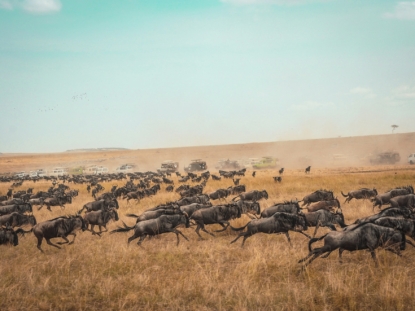
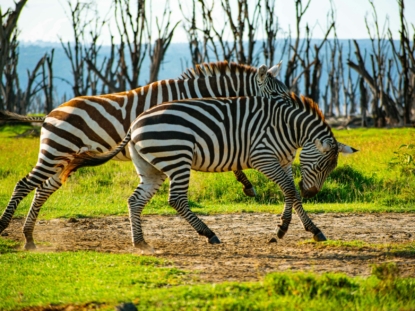
Tsavo East doesn’t perform for the camera. It waits for you to slow down. Then it gives you a herd of red elephants wading the Galana at dusk, a maneless lion flat under a thorn tree, oryx and zebra sweeping across plains that run to the horizon, and the Yatta Plateau lying like a dark river across the land. No crowds, no jockeying vehicles, just space, silence and the wild on its own terms.
Game Drives and the Galana River
A game drive in Tsavo East centres on water, since the few permanent sources concentrate wildlife across the dry plains. The Galana River, the park’s lifeline, draws elephant, buffalo, antelope and crocodile to its green banks, with Lugard Falls tumbling over sculpted rock and Crocodile Point nearby.
Aruba Dam, built on the Voi River, is another magnet that pulls in thousands of animals and predators, while Mudanda Rock, a long whale-back outcrop, overlooks a waterhole where elephants gather. Drives feel expansive rather than crowded. The water points are where the action is. African Safari Trails plans drives around the rivers and dams.
The Yatta Plateau and Landscapes
Tsavo East is as much about scenery as wildlife. The Yatta Plateau, running along the park’s western edge above the Athi River, is the longest lava flow in the world at around 290 kilometres, a vast dark ridge that defines the horizon. Mudanda Rock rises like a ship from the plains.
The park is otherwise flat, dry and open, with red earth, baobabs, acacia and Commiphora scrub, which makes wildlife easier to spot than in the hilly west. The big skies suit photography and stargazing. The space is the scenery. African Safari Trails builds in the landmarks alongside the wildlife.
The Man-Eaters of Tsavo
Tsavo carries one of Africa’s most famous wildlife legends, the man-eating lions of 1898, when two maneless males killed many workers building the Kenya-Uganda Railway and halted construction for months, a saga later dramatised on film. The story is part of every Tsavo visit.
The maneless lions remain a Tsavo trademark, the males growing almost no mane, thought to be an adaptation to the heat, so large that first-timers mistake them for lionesses. The history adds a layer to the wild country. The lions themselves are still very much here. African Safari Trails brings the story to life through its guides.
Birds of Tsavo East
Tsavo East is a birding stronghold, with over 500 species recorded across its plains, river and dam habitats. The Galana River and Aruba Dam draw waterbirds, herons, kingfishers and sacred ibis, while the dry plains hold bustards, hornbills, lovebirds and the Somali ostrich.
Raptors are common over the open country, and the green months from November bring migrant species and the best birding of the year. The variety rewards anyone who looks up between game sightings. Birding pairs well with the big-game viewing. African Safari Trails can add a birding focus to a Tsavo safari.
Red elephants
Large herds tinted brick-red by the iron soil, gathering at the Galana River and Aruba Dam, the park’s signature sight.
The Galana and water points
The lifeline river with Lugard Falls and Crocodile Point, plus Aruba Dam and Mudanda Rock, where wildlife concentrates.
Yatta Plateau
The world’s longest lava flow at around 290 kilometres, a dark ridge defining the park’s western horizon.
Big game and birds
The Big Five with Tsavo’s maneless lions, plus oryx, gerenuk and hirola, and over 500 bird species.
Combining Tsavo East with the Coast
Tsavo East’s position makes it the natural bush half of a Kenya bush-and-beach safari. It sits closer to the coast than to Nairobi, around three to four hours from Mombasa, so a couple of nights here slot neatly before or after the beaches of Diani, Watamu or Malindi.
The park is reached by road from Mombasa or Nairobi, by the SGR train to Voi, or by light aircraft to its airstrips, making the bush-and-beach link easy. It is designed for exactly this pairing. The transition from red plains to white sand is a classic. African Safari Trails ties Tsavo East to the coast in one trip.
Best Time for a Tsavo East Safari
The dry season is the best time for a Tsavo East safari, when the sparse cover and concentrated water make the most of the open plains. The green season brings birds and fewer visitors but tougher tracks in places.
June to October (long dry season)
The prime window, with wildlife gathered at the Galana and Aruba Dam, low grass, clear light and good roads across the plains.
January to February (short dry season)
Hot, dry and excellent for game viewing between the rains, with the herds again drawn to the permanent water.
March to May, November to December (rains)
Green, quiet and rich in birds, with lower lodge rates, though some southern tracks turn muddy or impassable.
Give it at least two nights, focus on the water, and pair it with the coast. Tsavo East rewards patience and space rather than racing for sightings, so allow two nights minimum to take in both the Aruba and Galana zones without rushing, and build your drives around the river and dams where wildlife concentrates, especially in the dry season. The dry months from June to October and January to February give the easiest viewing and best photography light. Its closeness to Mombasa makes it the obvious bush half of a
bush-and-beach trip, with the SGR train an easy way in. African Safari Trails sets the pace and the pairing.
Getting There and Practicalities
Tsavo East lies east of the Nairobi-Mombasa highway in Taita-Taveta County, roughly equidistant between the two cities, with main gates at Voi, Bachuma, Manyani, Mtito Andei and Sala. The SGR train stops at Voi, and airstrips at Voi, Aruba, Sala and Ithumba take light aircraft.
Entry is managed by KWS on a cashless, prepaid basis through the eCitizen system, with fees set by visitor category and valid for 24 hours, and the usual plastic-free and stay-in-vehicle rules apply. A guided trip handles all of it. Access is easy from either city or the coast. African Safari Trails arranges the tickets, transport and guide.
Tsavo East National Park FAQ
How much does Tsavo East National Park cost to enter?
Under the current KWS fees, non-resident adults pay around 80 US dollars per day, African citizens about 40 dollars, East African citizens roughly 1,000 Kenyan shillings and Kenya residents about 1,350 shillings, with reduced rates for children, charged per 24-hour stay. Vehicle and camping fees are extra. African Safari Trails includes park fees in a clear, all-in quote.
What is Tsavo East famous for?
It is best known for its red elephants, herds stained brick-red by the iron-rich soil, along with the Galana River, the Yatta Plateau lava flow, Tsavo’s maneless lions and the legend of the man-eaters of 1898. It is also Kenya’s largest park. African Safari Trails builds these highlights into a safari.
Is Tsavo East better than Tsavo West?
They are different. Tsavo East is flat, dry and open with big elephant herds and easier wildlife spotting, while Tsavo West is hilly, green and scenic with Mzima Springs and lava flows. Many travellers visit both for a complete Tsavo experience. African Safari Trails can combine the two.
How many days do you need in Tsavo East?
At least two nights lets you enjoy both the Aruba and Galana areas with an arrival drive, a full day and a morning drive, while three nights covers it without rushing. One night is too little given the park’s size and the travel time. African Safari Trails sets the right length.
Can you combine Tsavo East with a beach holiday?
Yes, easily, and it is the classic pairing. Tsavo East is only three to four hours from Mombasa, so a couple of nights here slot neatly before or after the beaches of Diani, Watamu or Malindi for a bush-and-beach trip. African Safari Trails ties the park to the coast in one itinerary.
When is the best time to visit Tsavo East?
The dry seasons from June to October and January to February are best, with wildlife gathered at the Galana River and Aruba Dam and easier driving, while the green months bring birds and fewer crowds but some muddy tracks. African Safari Trails times your safari for the best conditions.
Plan Your Tsavo East Safari with African Safari Trails
Building drives around the rivers and dams, giving the park the time its size needs, and pairing the bush with the coast all go more smoothly with someone who knows Tsavo East, so you find the red elephants at the water rather than searching empty plains. African Safari Trails has spent years building Tsavo safaris and bush-and-beach trips, with guides who know where the herds gather and the maneless lions lie up by instinct rather than a brochure. They will tell you straight how long to give the park and how to combine it with the coast, and handle the tickets, transport and transfers quietly in the background.
Want a proper quote, or just a steer on planning a Tsavo and beach trip? Reach out to African Safari Trails and a real person gets back to you.