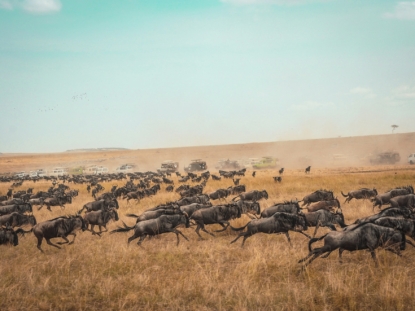
The Great Migration in Kenya is the arrival of more than a million wildebeest and zebra in the Maasai Mara, famous for the dramatic Mara River crossings between roughly July and October. African Safari Trails arranges Great Migration safaris in the Mara, timed and placed for the best chance of a crossing. The herds, the predators and the river drama make it one of Africa’s greatest wildlife spectacles.
Each year more than a million wildebeest, joined by hundreds of thousands of zebra and gazelle, pour north from Tanzania’s Serengeti, where the migration in Tanzania spends much of the year, into Kenya’s Maasai Mara in search of fresh grass. The high drama comes at the Mara River, where the massed herds plunge down the banks into crocodile-filled water while big cats wait above. It is one of the natural world’s great shows, and the Mara is where you watch it. African Safari Trails times and places a safari for the best odds of seeing it.
What the Great Migration Is
The Great Migration is not a single event but a year-round, clockwise circuit of roughly two million animals around the Serengeti-Mara ecosystem, following the rains and the fresh grazing they bring, and the Kenyan leg is one chapter of the wider Great Migration in East Africa. Around 1.5 million wildebeest move with hundreds of thousands of zebra and gazelle in a loop of some 800 kilometres.
Kenya’s part of the story is the northern leg, when the herds cross into the Maasai Mara and must brave its rivers. The movement is driven by nature, not a timetable, so it shifts year to year. The Mara is the climax of the loop. African Safari Trails plans around how the season is actually running.
When the Herds Reach the Maasai Mara
The herds generally reach Kenya’s Maasai Mara from around July, build through August and September, and start drifting back south to the Serengeti from late October into November. So the broad window to see the migration in Kenya is July to October, with the peak in August and September.
Because the movement follows the rains, the timing varies each year and can run early or late, so some flexibility helps. The herds can arrive as early as June in some seasons. Nature sets the schedule, not the calendar. African Safari Trails watches the season and advises on timing.
The Mara River Crossings
The river crossing is the moment everyone comes for. Massed wildebeest gather on the steep banks of the Mara River, hesitating for minutes or hours, until a few plunge in and thousands follow in a chaos of dust, water and noise, while crocodiles strike and the current takes the weak.
Crossings are most likely from late July through September, and again on the return south around late October. They are utterly unpredictable, so seeing one takes patience, luck and being in the right place. No guide can promise a crossing. African Safari Trails positions you where the odds are best.
Nothing prepares you for a Mara River crossing. The herds stack up on the bank, thousands deep, snorting and shifting, while the crocodiles drift into position below. Then, with no obvious signal, one wildebeest leaps and the whole mass pours over the edge in a thunder of hooves and spray. You watch with your heart in your mouth as they fight the current and the jaws, until the survivors haul out on the far bank and trot off as if nothing had happened.
Where to Watch in the Mara
Within the Maasai Mara there are several places to base yourself for the migration. The main reserve holds the most famous crossing points along the central Mara River and offers the heaviest concentrations, though it draws the most vehicles at a crossing.
The Mara Triangle, the western section, is well managed with fewer vehicles, while the private conservancies on the northern and eastern edges give quiet, uncrowded viewing of the herds and superb big-cat action away from the crowds. Each has its own balance of drama and space. Placement matters hugely. African Safari Trails picks the base that suits you.
Predators and the Wider Spectacle
The migration is as much about the hunters as the herds. The Mara holds Kenya’s densest big-cat populations, and the arrival of so much prey brings lion, leopard, cheetah and hyena into the open, with crocodiles working the rivers, so the predator action on game drives in Kenya is exceptional through these months.
Even between crossings the plains are alive with vast herds, newborns, dust and constant movement, a spectacle in their own right. The drama runs all day, not just at the river. The whole ecosystem comes to life. African Safari Trails builds drives around both the herds and the cats.
Beyond the Migration: a Fuller Mara Safari
A migration trip is also a chance to enjoy the Maasai Mara at its richest. A dawn hot air balloon safari over the herds, a Maasai village visit, and long game drives among resident lions, elephants and giraffe all round out the days between river-crossing vigils.
The Mara rewards more than one or two days, given how unpredictable the crossings are, so a longer stay raises your chances and deepens the experience. There is far more here than the river. The reserve is superb in its own right. African Safari Trails builds a full Mara programme around the migration.
Mara River crossings
The dramatic plunge of massed herds into crocodile-filled water, most likely from late July through September, never guaranteed but spectacular.
Big-cat action
The Mara’s dense lion, leopard and cheetah populations hunt the arriving herds, giving some of Africa’s best predator viewing.
Where to base
The main reserve for the famous crossings, the quieter Mara Triangle, or private conservancies for uncrowded herds and cats.
Balloon and culture
A dawn hot-air balloon safari over the herds and a Maasai village visit round out the days between crossings.
Best Time and Planning for the Migration
The window to see the migration in Kenya is July to October, with August and September the peak for river crossings. Booking early matters, since the best camps fill many months ahead, and building in a few flexible days greatly improves your chances.
July to August (arrival and crossings)
The herds pour into the Mara and the first big river crossings begin, the most dramatic phase, with busy camps and premium rates, so book early.
September to October (peak and late crossings)
Crossings continue, the herds spread across the plains and conservancies, predator action is superb and October brings smaller crowds.
November to June (herds in Tanzania)
The migration has mostly moved south, but the Mara still offers excellent resident wildlife, fewer crowds and lower rates outside the peak.
Stay several nights, book early, and keep your plans flexible. The crossings follow the herds and the rains rather than a schedule, so no operator can promise one on a given day, and the best insurance is time: plan at least three or four nights in the Mara during the July-to-October window to raise your chances of catching a crossing. The top camps near the river sell out twelve to eighteen months ahead for August and September, so book well in advance, and consider a private conservancy for quieter viewing away from the vehicle crowds at the main crossing points. A good guide with a radio network is worth a great deal for positioning. African Safari Trails handles the timing, placement and booking.
Getting There and Practicalities
The Maasai Mara lies in south-western Kenya, reached by a roughly five-to-six-hour drive from Nairobi or a short scheduled flight from Wilson Airport to one of the Mara airstrips. Flying in saves a long road day and is popular for migration trips given the distance.
The Maasai Mara is a national reserve managed by the county and the conservancies rather than by the national park service, with entry fees by category, and a 4×4 with a pop-up roof is the standard vehicle. Flying maximises time at the river. African Safari Trails arranges the flights or drive, fees and guide.
Great Migration in Kenya FAQ
When is the best time to see the Great Migration in Kenya?
The herds are in the Maasai Mara from roughly July to October, with August and September the peak for the dramatic Mara River crossings. The timing shifts each year with the rains, so some flexibility helps, and the herds occasionally arrive as early as June. African Safari Trails times your safari for the best chance of a crossing.
Are river crossings guaranteed?
No. Crossings are driven by the herds’ hunger and the rains, not a schedule, so they are completely unpredictable and no guide can promise one. The best way to improve your odds is to stay several nights in the peak season and use a guide who knows the crossing points. African Safari Trails positions you where the chances are highest.
How many days do you need for the migration?
At least three or four nights in the Maasai Mara is wise during the migration season, since the crossings are unpredictable and more time raises your chances of catching one, while also allowing fuller game viewing. A single night risks missing the action entirely. African Safari Trails sets the right length for a migration trip.
How much does a Great Migration safari cost?
It varies widely with the season, the camp and the vehicle, and peak migration months carry premium rates, especially at camps near the river. Park or reserve fees, flights and whether the vehicle is private all affect the total. Booking early secures both space and better value. African Safari Trails gives a clear, all-in quote.
Should you stay in the reserve or a conservancy?
The main reserve has the famous river crossings but the most vehicles, while the private conservancies on the Mara’s edges offer quieter, uncrowded viewing of the herds and cats, plus off-road and night drives, at a higher rate. Many trips combine both. African Safari Trails advises on the best base for you.
Can you combine the migration with the rest of Kenya?
Yes, easily. A migration trip pairs well with Amboseli, Lake Nakuru, Samburu or the coast for a fuller Kenya safari, or with Tanzania’s Serengeti for the other half of the ecosystem. The Mara is usually the centrepiece. African Safari Trails builds the migration into a wider itinerary.
Plan Your Great Migration Safari with African Safari Trails
Timing the trip to the season, choosing between the reserve and the conservancies, securing camps that book out a year ahead and giving yourself enough nights for an unpredictable spectacle all go more smoothly with someone who follows the migration year after year, so you give yourself the best possible chance of a crossing rather than arriving a week too early. African Safari Trails has spent years building Mara migration safaris, with guides who know the crossing points and the herds’ patterns by experience rather than a brochure. They will tell you straight what the season is doing, how long to stay and where to base, and handle the flights, camps and fees quietly in the background.
Want a proper quote, or just a steer on timing a migration trip? Reach out to African Safari Trails and a real person gets back to you.